SNAP Cuts are Putting Pressure on Arizona Families
It’s no secret that grocery prices are going up. In Arizona, the cost of groceries remains high, rising 4% between January 2025 and 2026, largely due to tariffs, with unemployment rising during the same period. Americans need all the help they can get at checkout – so recent cuts to Supplemental Nutrition Assistance Program (SNAP) benefits are making already-stretched household budgets even tighter. Here’s what those cuts mean for Arizonans.
The Republican Tax Law Is Reshaping SNAP Funding and Eligibility
In 2025, President Trump signed H.R. 1 (the Republican Tax Law) into law, enacting historically large cuts to SNAP. The law includes a structural change that shifts SNAP costs to states. Starting in 2027, most states will have to pay between 5 and 15 percent of SNAP benefits costs, totaling hundreds of millions of dollars a year in many states. Beyond reducing federal spending, the Republican Tax Law fundamentally changes how SNAP is financed and administered. The legislation shifts part of the financial burden to states, creating new pressure on state budgets and increasing the likelihood that states will respond by tightening eligibility requirements or reducing participation.
The law cut federal funding for SNAP benefits by $187 billion through 2034, affecting the more than 40 million people who receive food assistance through SNAP each month. Around 2.4 million people were projected to lose SNAP entirely in an average month due to the new law, including 73,000 Arizonans – but the actual numbers are much higher, just months into the cuts. Children make up more than 40% of Arizona’s SNAP recipients. Experts estimated that SNAP participation fell by more than 3.5 million people between the Republican Tax Law’s passage and February 2026.
Arizona Seeing Sharp Declines in SNAP Participation
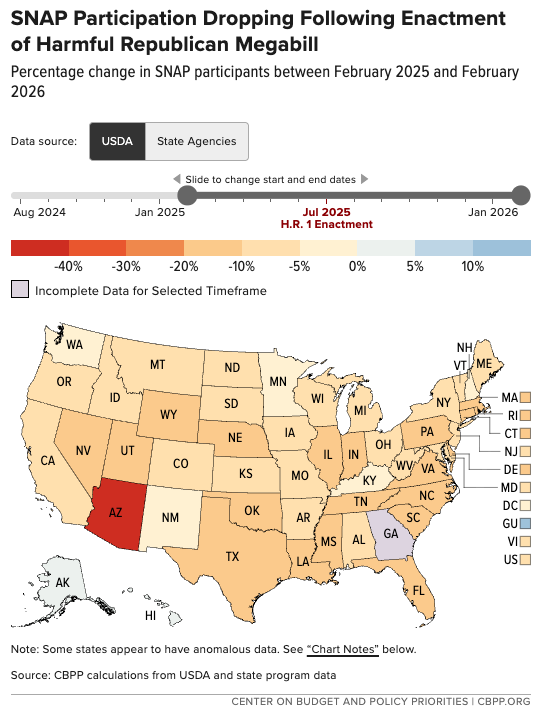
In the months after the passage of the Republican Tax Law, SNAP enrollment fell dramatically in Arizona – by 51%, the most significant decline in the country. As of April 2026, SNAP enrollment has declined by 473,793 people, including 205,223 children. In Pima County alone, more than 75,000 people lost their benefits. Food banks are reporting seeing surges in new visitors. Administrative barriers have made SNAP more difficult to access, with applicants reporting long waits for application and recertification approvals and challenges reaching agency staff by phone. The decline is happening without improving economic conditions, meaning that the change in enrollment numbers cannot be attributed to people finding jobs.
Source: CBPP
Children Facing Heightened Food Insecurity Risks
The cuts are causing food insecurity to reverberate, especially for families with children. Experts predicted that 1 million children would see food assistance to their families slashed or eliminated, including half a million children whose households will receive less than $100 per month on average. But the actual numbers could be much higher – in only 12 states with available data, 700,000 children have already lost SNAP benefits. Additionally, in an average month, 96,000 children will receive fewer food benefits through programs like free school meals and summer meal programs. Research shows that childhood food insecurity has long-term consequences extending beyond hunger itself. Reduced access to nutritious food is associated with poorer educational outcomes, increased behavioral challenges, and worse health outcomes over time.
Vulnerable Groups Losing Protections
Veterans are also getting the short end of the stick. The new law targets veterans, people experiencing homelessness, and people aging out of foster care, by removing an exemption from a non-evidence-based reporting requirement. This change could leave more than 147,000 Arizonans without reliable access to food.
Loss of SNAP-Ed Reduces Nutrition Resources
The Republican Tax Law also ended SNAP-Ed, the longstanding education arm of SNAP. SNAP-Ed brought nutrition education to 2 million Americans annually, and another 10 million through community collaborations. Arizona’s SNAP-Ed program, AZ Health Zone, served over 18,000 youth in education activities, led 5,800 nutrition education classes, and established and maintained 61 community gardens in 2024.
Retailers are also facing tighter budgets and being forced to close due to SNAP cuts. The measures are making it harder for small grocers to stay in business, especially in communities with high rates of SNAP participation. In rural areas, $1 of SNAP spending translates to roughly $1.50 in local economic activity during recessions. This means that even if families in these communities don’t personally rely on SNAP, they could see their local grocery stores close due to reduced cashflow across the board. In Arizona, 175 grocery stores will face financial instability and decreased business due to the Republican Tax Law’s SNAP cuts, with Apache and Navajo Counties at the highest risk. Rural communities may be particularly vulnerable because they often have fewer food retailers and thinner profit margins. As consumer spending contracts, communities risk losing essential services and increasing reliance on emergency food networks.
Together, these changes illustrate that SNAP cuts affect more than individual benefit recipients. As Arizona experiences one of the steepest declines in SNAP participation in the country, the effects of the Republican Tax Law are likely to continue extending well beyond grocery store checkout lines.